

Gr3ML1N ESP32 cyberdeck by Andy Warburton
It’s graduation season. I attended the graduation of my niece from Wellesley College on Friday. A graduation is full of advice but also hope for the future — as a class of students now sets off to make their mark in the world. But such advice is worth hearing no matter when or if you graduated. I share some of this advice from two of the speakers, both Black women, not because they talked about makers and making but because they spoke about the things that make us human. I want to congratulate all the 2026 graduates and add that a cyberdeck makes a great graduation gift.
Table of Contents
“I am, because we are”
Elise Christina Wilson gave an excellent student address at the Wellesley graduation.

Elise Christina Wilson ‘26 (Photo courtesy of Wellesley College)
She talked about the individual’s relationship to clan and community, using a term her Ghanian “Nana” shared with her: ebusua.
“Among the Akan people of Ghana, ebusua means clan—a concept that reminds us that we belong to something: I am, because we are. Wherever we go, we carry our ebusua with us—our clan, our community, our family.”
Elise Wilson went on to explain that she found this community at Wellesley and it was something she would carry forward with her.
You can find the text of the commencent address by Elise Christina Wilson here.
I’d like to apply her thinking to the maker community, and that our own lives have meaning and purpose because we are part of a community that knows us and cares about what we do.
Dr. Ruth Simmons on the lessons learned from failure
To be honest, I didn’t know anything about Dr. Ruth Simmons. Shame on me. Her life story is truly remarkable and inspiring. She grew up the youngest of 12 children of sharecroppers on a cotton farm in East Texas. “I lived on the Murray Farm, a massive plantation on which my large family of 12 children lived in an unprepossessing shack from which we ventured out daily to work the fields on the property. This was the setting that marked my early life and that, I now find, shaped me in so many ways,” she said.

Dr. Ruth Simmons (photo courtesy of Wellesley College)
Her first grade teacher in a segregated school let her know that “the work of the mind was as important, as useful, and as powerful as physical labor.” That motivated her, in part to compete with her older siblings. But she was also driven by her perception of how she would be treated in society. “It was the omnipresent assertion in the 1940s and ’50s that, because I was Black, I possessed less intelligence, less imagination, less creativity, and, of course, fewer rights, than whites, that no doubt prompted my interest in proving my intelligence.”
She continued: “At the age of 7, there was no way for me to understand the motivation for such a hostile regard. Still, I wanted to learn for myself whether my mind and character could prove me equal to others. Not certain that I could convincingly demonstrate my ability to others, I began by trying to demonstrate it to myself. Each of us, in order to be at peace with who we are, should recognize that our personal standards are more important by far than any others try to impose upon us.
Dr. Simmons spent her junior year of college at Wellesley. Previously, she had only experienced segregated learning environments. She said that the year at Wellesley opened her mind to a wider world but it also “introduced me to failure,” which she said was the greatest lesson she learned.
She struggled in a French class. When she went to the professor to say that she wanted to drop the class. what he told her made her think of him as “the cruelest of instructors.” His curt response was “Just work harder.” She wanted to drop out of college but instead she couldn’t afford the trip home so instead she worked harder on studying French. She went on to get her PhD in Romance Languages and Literature from Harvard University.
From the day I learned that I could conquer my fear, dig deeply, and provide my own rescue from failure, I lost all fear of undertaking challenging tasks. Today, when asked why I have led with what many presume to be courage, I relate this story about how this experience at Wellesley allowed me to shed the sense of inferiority imposed upon me during my childhood. I have led with an understanding that failure is tragic only if our efforts lack the intensity worthy of the goal we pursue.
Dr. Ruth Simmons has been President of Smith College, Brown University and Prairie View A&M. She told the graduating class of 2026:
Do not run from engagements that elevate your humanity, that sharpen your understanding and point you to rewarding work that can change your life forever. I am today defined by the lesson of the French course that I wanted to drop. Always leave room for lessons taken from failure. Learn to call yourself back from the precipice when you are prepared to abandon difficult work that can change your life and make a difference for others. It happens that great success and happiness often arise from failures and disappointments that our imagination magnifies to tragic status. They are often not tragic at all but merely setbacks offering the learning, growth, and resilience that we are privileged to enjoy as humans.
Here is the full text of the commencement address of Dr. Ruth Simmons.
Psy DeLacy: Pixar’s Best Supporting Maker
Kevin Toyama wrote about the makers of Pixar in Make: V97 and you can find the article in full on Make: Substack here. This is an excerpt of the article that focuses on Psy DeLacy.
If there’s one person who spreads the gospel of the joys of making, it’s Pixar’s Crowds Technical Director Psy DeLacy, whose credits include Incredibles 2 (2018) and Luca (2021).

Psy DeLacy likes to share how she blew up the second BB-8 she built because she didn’t understand electricity. It’s OK to fail! (Photo courtesy of Psy DeLacy).
DeLacy’s known for her robotics work with the Bay Area Droid Builders and Sacramento Astromech Builders, whose spectacular BB-8 has graced Maker Faire Bay Area, Star Wars Celebration, and her beloved DragonCon. But that’s actually selling her short.
She has an incredible maker range, one that’s continuously expanding thanks to her unquenchable curiosity about how things work. DeLacy knows Autodesk Fusion, Maya, Houdini, and ZBrush, and can basically make anything in 3D. She can mill, weld, and drywall. She designs and sews costumes. Bakes Flamin’ Hot Cheeto macarons. She even learned to build bicycle frames from Koichi Yamaguchi, who was the master frame builder for Japan’s famed 3Rensho bicycle company and who became the official frame builder of the U.S. Olympic Cycling Team. And best of all, she makes her skills and experience available to all her coworkers.

Don’t throw that out! Psy DeLacy disassembles a bricked robot dog for its servos. (Photo courtesy of Psy DeLacy).
DeLacy turned her office into a makerspace so that anybody could just come in and borrow tools and equipment. There’s a 3D printer (to go along with the six she has at home), a vinyl cutter, and a full workbench loaded with tools. She describes her office as Droid Depot from Star Wars: Galaxy’s Edge at Disney World mashed up with her personal aesthetics. “I want my office to be warm and inviting because I want people to come in and borrow stuff,” said DeLacy. “I want people to come use the oscillating tool. You might accidentally cut a hole in the wall, but you’ll learn something doing it — and you can always patch it up.”

Need a soldering kit? Japanese pull saw? Orbital sander? Head to Psy DeLacy’s office. Note the diamond-plate flooring! (Photo courtesy of Psy DeLacy).
One of her favorite experiences was with Pixar University, the company’s professional development program where experts train new employees and teach technical job skills. But instead of teaching how to use new software, DeLacy taught classes like how to make an electric guitar. “Creativity is creativity, and sometimes that’s fostered by doing figure drawing and sometimes that’s fostered by sitting with a soldering iron for three hours and building a Nixie clock,” said DeLacy. “I love Pixar because they recognize that.”
And she welcomes people into her office-cum-makerspace with unbridled enthusiasm: “Whenever somebody doubts they can make something, I’m like, ‘You can absolutely do it. I’ve got a saw in my office. I’ve got screwdrivers. I’ve got Wago connectors. Let’s do it, right now.’ That notion that they can come in here and borrow a tool and not return it because it accidentally landed in the swimming pool? That’s fine, it’s just a tool. But go and try it. I want to contribute to that Pixar culture of spreading joy and creativity just for the heck of spreading joy and creativity.”

“Why, yes, Earl Brawley, I do have a flamethrower you can borrow!” It was used for yakisugi, a Japanese wood-preservation technique. (Photo courtesy of Psy DeLacy).
On Rad Cyberdecks
Make: Editor Sam Freeman explores the world of cyberdecks such as the Mac Mini Cyberdeck enclosure by Will Haude, aka 3D Brooklyn, shown below.
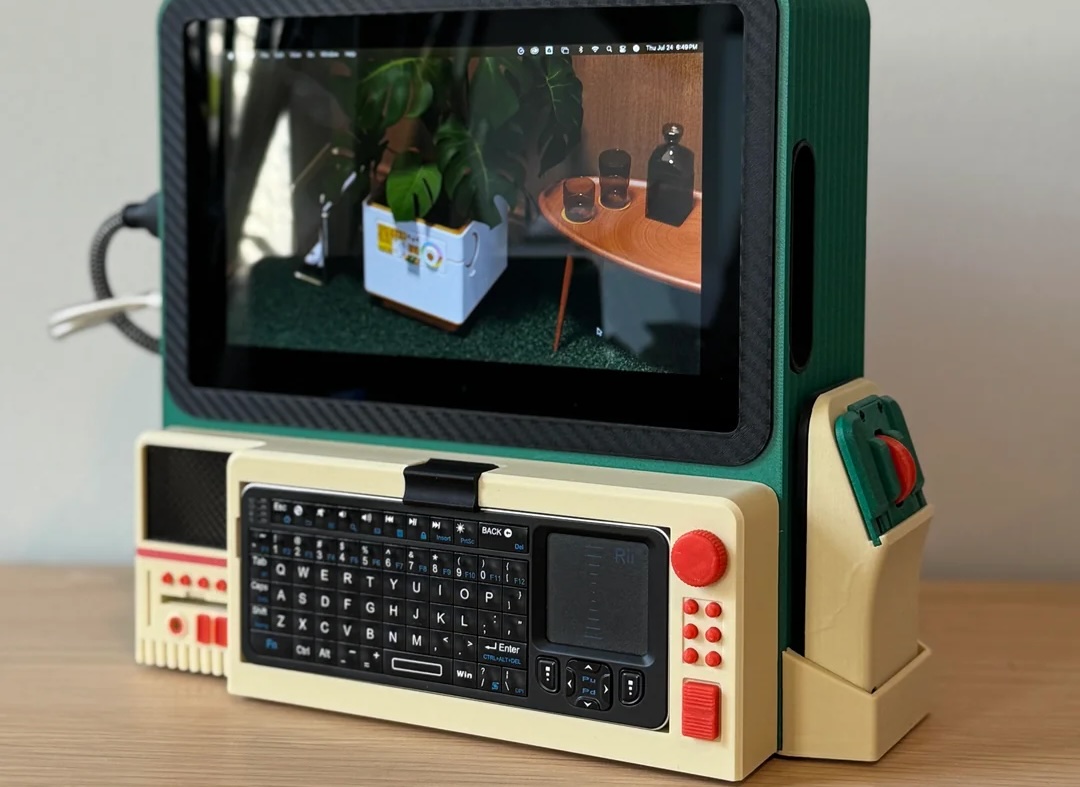
Sam heard from one of the makers featured in the article, Kati (@miss.molerat) who appreciated that we didn't reduce the "trend" to cute aesthetics. "This article actually captures what many of us love about our cyberdecks: ownership, scavenging, repairability, resisting disposable tech and making things your own again."
Make Things is a weekly newsletter for the Maker community from Make:. This newsletter lives on the web at makethings.make.co
I’d love to hear from you if you have ideas, projects or news items about the maker community. Email me - [email protected].
