

I am excited to share that Make: is now on Substack, a popular publishing platform for long-form stories. You can find it at makezine.substack.com. Why, you might ask?
The simple answer is to reach new audiences who may not know about Make: and realize that there are all kinds of people who build, tinker, craft, invent and make. We will be sharing original stories like our first story by John Jones, as well as stories from the pages of Make:. We have about 35,000 subscribers to the print edition of Make: magazine and we’d like to reach hundreds of thousands of people, if not more.
Please check out makezine.substack.com and subscribe. I will continue to do this newsletter, which is produced on Beehiiv, but I may decide to integrate it into Substack at some point.
Table of Contents
Make: on Substack: A Rocket Playhouse of Your Own
Our first story on Substack comes from John Jones, whose son became obsessed by a “2014 Make: video showcasing a dad’s home-built rocket playhouse for his two boys.” His son, Jack, pleaded with him to build one for him, and that’s what John did.
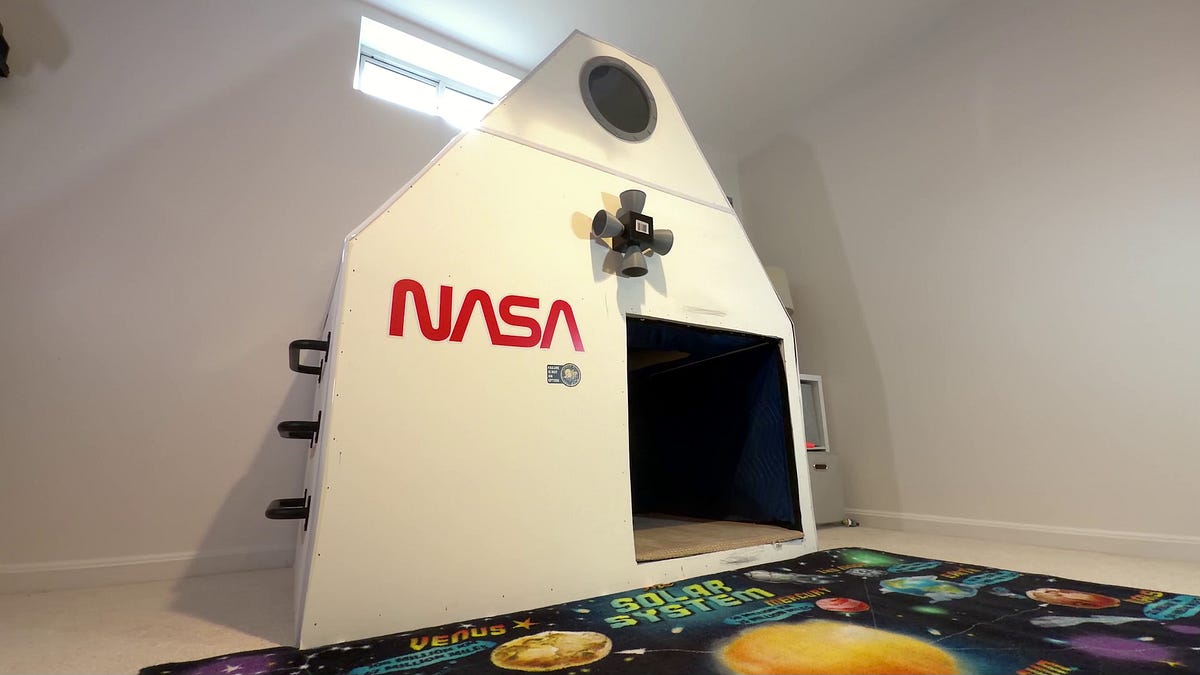
My favorite part of the story is that John shared the finished rocket with his own parents, he explained that his son wanted “a rocket playhouse of his own.” John wrote: “My dad smiled and said, ‘Yeah, so did I when I was a boy, but not many kids have a dad who can actually make one.’”
This is what makers can do!
Discover Make: in Santa Rosa Today
Make: is at the North Bay Science Discovery Day event today from 10am to 4pm PT at the Santa Rosa Fairgrounds. I’ll be heading over there once I finish this newsletter!

MAKEHERS Sacramento
MAKEHERS is accepting applications for a no-cost Women’s Small Business Accelerator in Sacramento, CA. There are 14 spots available and the deadline for applying is March 10. It is a program of Sacmade, and another good idea from Gina Lujan and team.
This program is designed to support women who are ready to grow an idea, launch a product, or strengthen an existing small business. Participants will gain hands-on guidance in product development, branding, pricing, and selling, while also accessing tools, equipment, and a supportive community of makers and entrepreneurs.
Alternatives to Etsy
In an editorial meeting, we were discussing what alternatives there are to Etsy. Etsy started as as community-oriented marketplace for buyers and sellers of handmade goods. Rob Kalin was one of the founders and launched Etsy in 2005, around the same time we launched Make:. In talking to Rob about what his small team of developers was building during the DotCom crash, he told me boldly that he wasn’t looking for VC funding and that it was easier than ever for a small team to build a robust web site. That conversation led me to think that there would be a next generation of the Web — the next big thing was the Web, again. I called it Web 2.0 and worked to create a conference of that name.
Kalin left Etsy in 2011 and then Etsy went public in 2015. While Etsy has seen reasonable success, it may no longer offer sellers the same opportunities it once did. For one, it is now easier to own your own store with platforms like Shopify, which we use on Maker Shed. There’s also Amazon Homemade.
While Etsy may be the largest marketplace of its kind, it is losing active sellers.
According to Etsy's Q3 2025 report, there are currently 5.5 million active sellers—meaning roughly 670,000 have left the platform in the past year.
Here is a link to the full article on EufyMake’s website that has an article listing 11 alternatives to Etsy.

Tuba Players and Makers
In the podcast, “Unspeakeasy With Meghan Daum”, the episode featuring author Sam Quinones, started out talking about the impact of drugs, the subject of his first two books, one of which “Dreamland” is about the opioid crisis in Appalachia. (I’ve read the book and it’s excellent.). Quinones talked about his new book, The Perfect Tuba.

After writing about drugs and addiction, Quinones stumbled upon tuba players, an admittedly small niche, but found that those who played in a band at school and worked to expand the range of what a tuba player could do had found something very satisfying. It seemed to me that he was talking about makers.
“It's where they're working at something slowly, not imagining immediate rewards, and demanding more of themselves, taking small steps towards progress, not imagining winning big on your next football game or whatever.
To me, all of these two groups, tuba players and band directors, all seemed like this answer to the legal economy. Like how people were more addicted and more depressed, and more anxious, and more isolated than ever. That's because we got away from the basic values that tuba and the band are teaching, which are as I said, perseverance, and working hard without expectation of reward always, and collaboration, and all these kinds of things.”
The name of the book comes from the search to build The Perfect Tuba — there are two tubas owned by the Chicago Symphony Orchestra, which are considered “perfect” and were made by a company that went out of business. Quinones tells the story of those who are trying to come close to that level of perfection using science and engineering. On the podcast, he mentioned Tom Treece, “an inveterate tinkerer from like the old days of inventors,” and Bob Carpenter, who plays the tuba for the Orlando Symphony; they're both engineers, they became consumed with creating the perfect tuba.”
Here is the YouTube version of this episode of the Unspeakeasy featuring Sam Quinones. The discussion of his book takes place in the latter half of the episode.
Serious Play
The Ray and Charles Eames were the epitome of 20th Century Design. The Eames Institute of Infinite Curiosity carries on their work into the present. Jen Blakeslee in Serious Play @ Eames Ranch wrote:
In 1961, Charles Eames said, “Toys are really not as innocent as they look. Toys and games are the preludes to serious ideas.” If you’ve seen the Eames’ plywood animals, masks, house of cards, or their films about spinning tops and bouncing balls, you realize that play wasn’t a break from work. It was the work. This serious play—a belief that whimsy, juxtaposition, and even toys could carry intellectual weight—is defining, and the legacy the Museum, the Ranch, and the Residency seek to carry on. Play, for them, wasn’t decorative. It was strategic. A way to attack problems elliptically. To prototype ideas dimensionally. To follow curiosity without demanding immediate payoff.
Her article on Makezine shows the work of the artists in residence at Eames Ranch.
Make Things is a weekly newsletter for the Maker community from Make:. This newsletter lives on the web at makethings.make.co
I’d love to hear from you if you have ideas, projects or news items about the maker community. Email me - [email protected].
