

A creative obot from Maker Faire Hannover
Maker Faire Hannover in Germany is happening today and tomorrow (August 15–16) with 200+ makers bringing robotics, art, AI, engineering, and wonderfully unexpected ideas to life. Back in the US, Maker Faire Meridian takes place today at the historic Soulé Steam Works in Meridian, Mississippi.
Table of Contents
Maker Faire Hannover
Here are some highlights from the 13th edition of Maker Faire Hannover.

Buzzbird: Not Just For Looking At
One of the highlights is “BuzzBird.” This several-meter-tall mechanical bird flaps its wings and interacts with visitors. Designed by Berlin-based artist and product designer Eitan Rieger, BuzzBird explores the connection between human movement and mechanical flight. spectacular metal structure in the shape of a bird with a five-meter wingspan. This artwork was specially developed for Maker Faire Hannover 2026 and invites visitors to interact with it.

Marine Tech: A Hydrophone and a Wave Simulator

Small piezoelectric speakers from birthday cards can do more than just produce sound. By using these transducers in reverse, you can build inexpensive hydrophones for underwater use with just a few electronic components. A complete replica system that requires only a few components and can be sampled via a sound card on a computer. In addition to the circuit diagram, the detailed calculations for the transistor circuit are also freely available as documentation. The total cost for assembly is less than €10.

The shape of coastal protection structures and the vegetation in the foreland of the dike are important factors that determine how strongly and how far waves penetrate inland, causing erosion or endangering property and lives. In a portable wave pool, a 3D-printed wave generator can simultaneously unleash a water wave onto two different shoreline scenarios. Create your own planting schemes using Lego bricks, build walls, design breakwaters, and directly compare the coastal protection concepts within these dike and shoreline structures.
Tetsuji Katsuda’s Music Train

Tetsuji Katsuda has brought his mechanical and robotic musical creations to many Maker Faires. In Hannover, he’s showing Music Train, a media art piece that visualizes the composition of music.
When you play the electronic piano, model trains move. The 12 rails correspond to the seven notes of Do(C), Re(D), Mi(E), Fa(F), Sol(G), La(A), Si(B) and the five sharp & flat notes in between. When you play Do(C), the train on the Do(C) track moves forward, and when you play Re(D), the train on the Re(D) track moves forward. If you stop playing for a while, the train will automatically return to the starting line.
You can use this system to play a game like horse racing. Before you start playing, line up the trains at the starting point. Predict which train will be in the lead after the song is finished. The position of the trains represents the frequency of each note of Do(C), Re(D), Mi(E) in the song.
Generally, Do(C) and Sol(G) appear more frequently in songs in C major, but as shown in the video above, Sol(G) appears most frequently in Twinkle, Twinkle, Little Star. In this way, Music Train makes it possible to visualize the composition of music in a particular song.
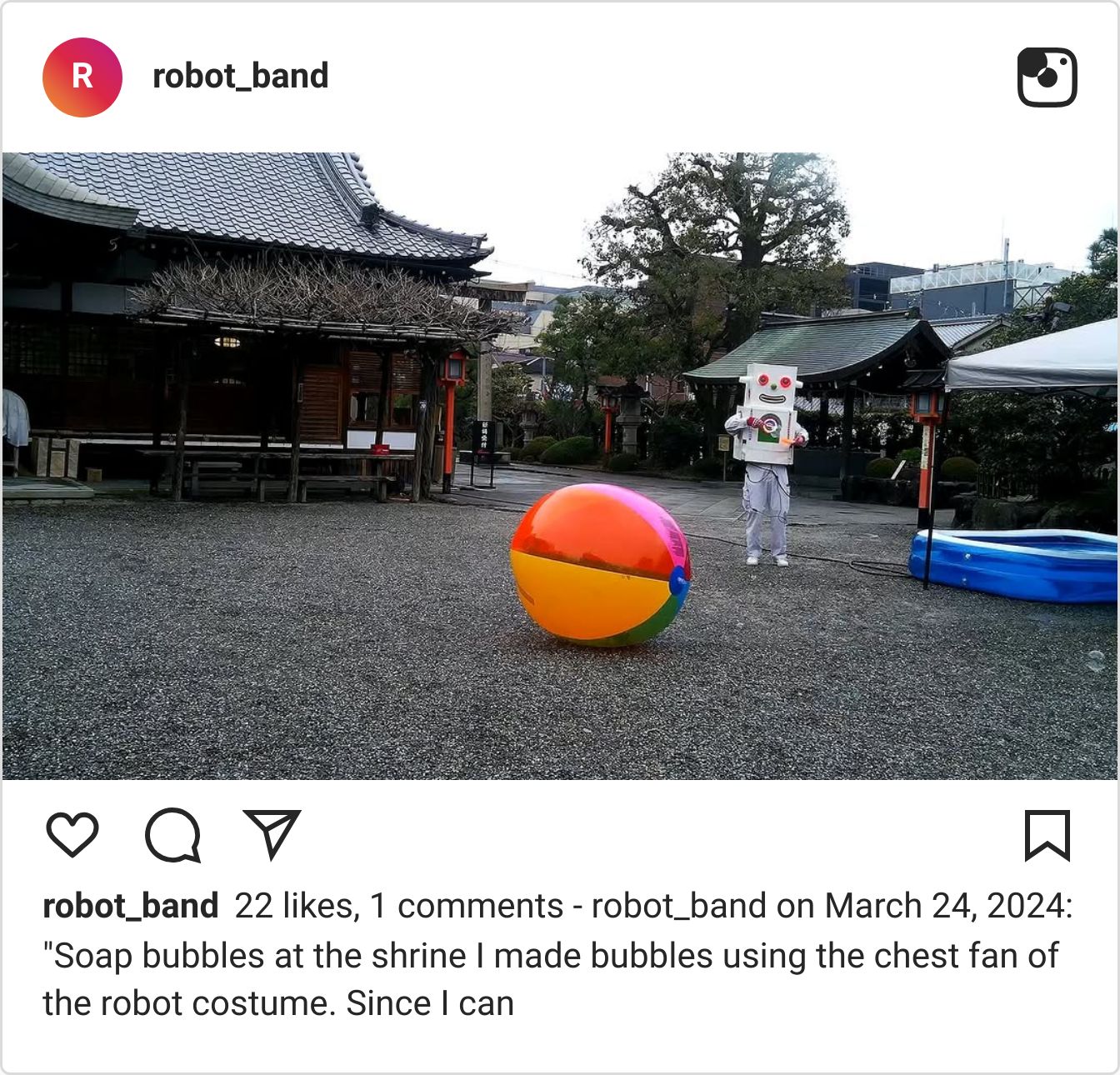
On his Instagram from 2024, Katsuda has an amusing video of him in a robot costume in Japan blowing bubbles from a chest fan.
A mobile VR pinball machine: Classic pinball meets virtual reality

“Flipper to go” is a mobile VR pinball machine that combines classic pinball action with immersive virtual reality. Visitors can experience firsthand what a pinball machine feels like when it’s no longer confined to a heavy cabinet, but instead becomes a compact, portable VR experience playable anywhere. Experience how physical gameplay, digital effects, and spatial representation come together – ideal for pinball enthusiasts, those curious about VR, or anyone who simply wants to try something new.
Flower Power
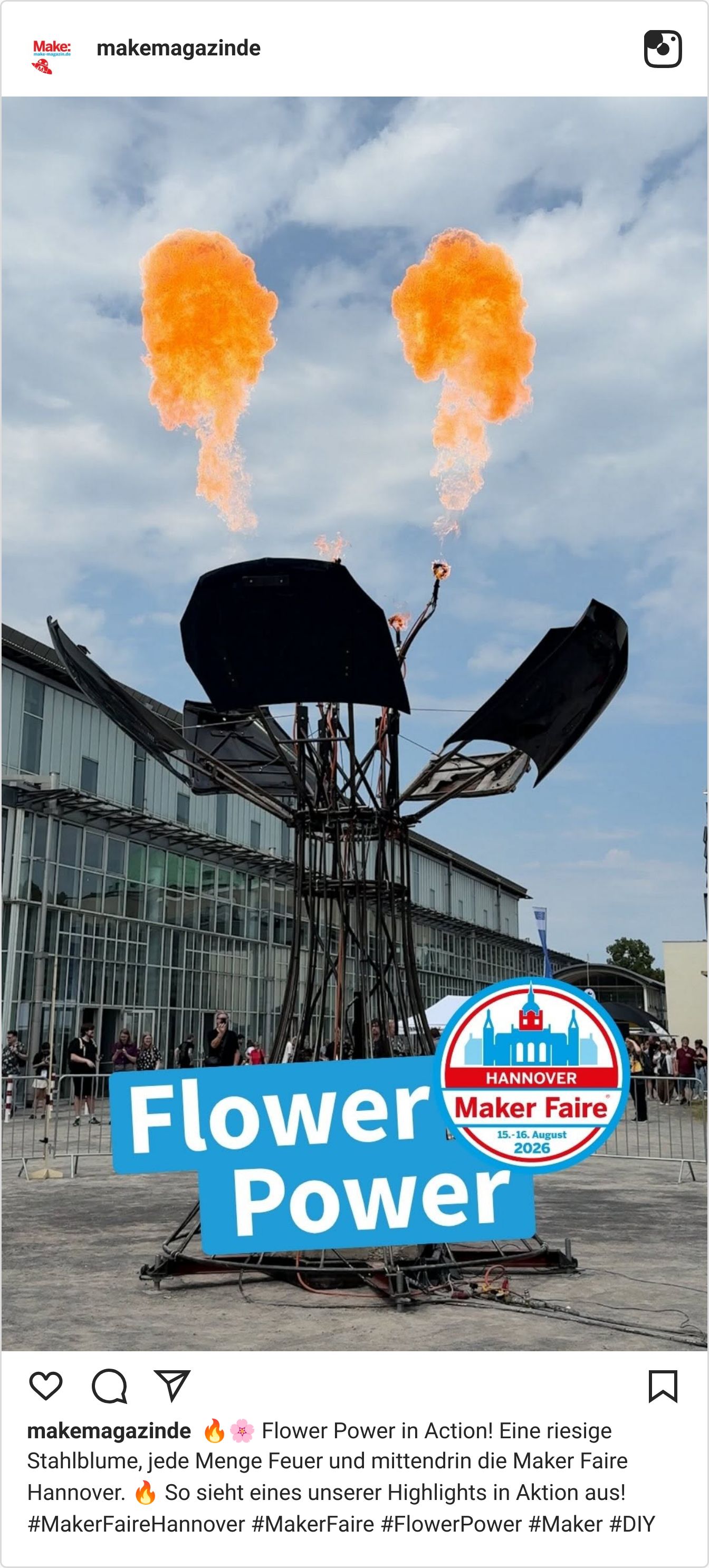
FlowerPower is a monumental steel flower made from car hoods, built exclusively for Maker Faire Hannover. By New Zealand artist Bibi Jordan, what makes Flower Power so special is its combination of sustainability and spectacle : it’s a spectacular recycling project that encourages direct interaction with visitors. The installation watches its visitors with cameras and responds to their movements. The more activity there is around the sculpture, the farther it opens its petals. When enough people gather, the big performance begins: flames shoot up from the flower. Hydraulics, image processing, and fire—this is a combination that just makes sense.
Make: in German
Maker Faire Hannover is organized by the Maker Media division of Heise, also located in Hannover. They publish Make: Magazine in German, developing their own projects and features. We’ve always liked their tagline: “Germany’s most dangerous DIY magazine.”

Steam and S.T.E.A.M
Taking place at the Soulé Steam Works, Maker Faire Meridian integrates new technology with the old. You can “witness real steam being generated on-site to power historic engines and hear the sound of authentic steam whistles.”

Maker Faire Meridian is a free event for families with activities and exhibits, in other words, Steam and S.T.E.A.M.

Robotics exhibit at Maker Faire Meridian 2023
25 years later, iPods are becoming popular again
In Return of the iPod, Craig Grannell writes that the iPod, which was first released in 2001, is experiencing a resurgence of interest among mainly a GenZ audience. It’s not like Apple is making iPods again, but young people are looking for used ones, perhaps even ones that their parents owned and have in a shoebox in the back of a closet.
That combination of subscription fatigue and digital detox — along with a dollop of wistfulness if you’re an older fan — makes an old-school iPod appealing. It lacks ads, AI, algorithms, and internet connectivity. Echoing vinyl’s resurgence, iPods shift music back to a self-contained space that you control. You curate your collection and decide what belongs.
It’s an interesting trend, even if it’s a niche. After having an all-in-one iPhone, some young people are breaking up with it by using iPods and cameras and other devices that don’t necessarily talk to each other or to the Internet. Want more control means making your own choices, not having others choose for you. Perhaps this kind of resistance to mass consumerism will lead them to becoming makers, and creating devices of their own.
Make Things is a weekly newsletter for premium subscribers to Make: Magazine and the Maker community. This newsletter lives on the web at makethings.make.co
I’d love to hear from you if you have ideas, projects or news items about the maker community. Email me - [email protected].
