

Makey enjoying a mouthful of Blue Raspberry Pi
Table of Contents
Raspberry Pi Day Collection
For Pi Day, we have a PDF of Raspberry Pi projects from the magazine.

Here’s a link to download the PDF of the Raspberry Pi Collection. You can also find Raspberry PI products on Maker Shed.
Alt.ctrl.GDC
This week, Editor Sam Freeman went to the Game Developer’s Conference in San Francisco.
Once again teams from around the world brought crazy contraptions to the alternative controller showcase alt.ctrl.GDC at GDC in San Francisco. From a creepy doll puzzle, to a giant monster mouth, to a human-sized hamster ball treadmill, most were made by teams with little previous hardware experience. Impressively, some were built in only a few weeks (or days) with parts from the Dollar store. But these creations of minimal resources delighted attendees, and would be a memorable exhibit at any Maker Faire.
sky-guided’s Plasma Toroid Generator
On the episode of Make: Live this week, we had a stimulating conversation with sky-guided, the author of the Plasma Toroid Generator article in Make: V96, which is now online. sky-guided, who wishes to remain anonymous in public, talked about how the Russian maker community has helped her with this project and she answered several really good questions from the audience.

Make: Editor-in-Chief, Keith Hammond, said he’s “been stalking this kind of project for years but there’s really wasn’t an approachable build. At Open Sauce last year, he saw a maker with one. When asked about it, he said that he didn’t build it; it came from sky-guided. This project, where the PCB was the coil, was what he was looking for. “It was a replicable, Make: magazine style project,” he said. “The article is beautifully written and beautifully photographed. One of my favorite things we've ever done.”

What’s the background on your project?
s-g: On a technical level, most of this project is not using technology that is fundamentally new. The first proof of concept of this phenomenon is actually in the 1930s. But it was just not something that was on the radar of the maker community until within the last 2 years or so. I guess about 3 years now. There was a video released from a YouTuber named Backpack Si, who was showing off the phenomenon. I saw a video in spring 2024 and my immediate thought was, that's the coolest thing I've ever seen. I need to make this.
What were the challenges you faced with this project?
s-g: What you're currently looking at is, I believe, revision 6 or 7. It was not until revision 4 that I had something that was really solidly working.
The circuit is, in some ways, fairly straightforward analog electronics that is building off of what the Tesla coil people have been doing for a couple of decades now. The thing that I'm bringing to the table is indeed, as we stated, the coil being part of the circuit board. There's not a separate, spiral hand-wound coil.
I really tried to take a design for manufacturing approach from the very beginning. There's so many projects out there that are one person who soldered up one thing that works exactly once. And these days, PCB fabrication is so accessible, the tools are so straightforward to use. The manufacturing is so cheap. To me, it makes sense just to go straight to the fully developed professional. I'm going to build one unit and then if I want to, I can build a 1000 units.
What about the globe?
s-g: At that time, I did have to contact a specialty neon artist to get the globe. The glass is still a bit of a bottleneck. This project has gotten enough traction that there are some small shops doing uh the grass blowing. And that's made this a lot more accessible in a lot of ways.
Have you given any thought to getting into glass blowing?
s-g: It's funny, building a neon sign was sort of on my bucket list for decades coming into this project, and now I feel like I've made something that is like the ultimate version of a neon sign. It's still plasma inside glass, but instead of electrodes, it's completely wireless. If I pick up the globe, the plasma will still be there, even if I physically have a couple of centimeters gap between the globe and the coil.
I have a lot of respect for those who are actually fabricating globes for this project.
So is it something you could buy?
s-g: The board is a completely open source project. I have the design files available in the code repository, which is linked from the Make: article. There are 3 or 4 shops now selling these globes. I bought this globe from the plasma artist Wayne Stratman in Massachusetts.
Could you use it off the shelf boiling flask instead of the globe?
s-g: Uh, yes and no.
An off-the-shelf boiling flask could be used globes. There’s a nice round bottom flask so they then fill and pinch off. I suppose if you got a good quality seal, there's no reason it wouldn't work. Xenon itself is kind of expensive, so you'd want to seal it once and then not have to be refilling it on a regular basis.
Keith Hammond: This is a project that kind of came out of nowhere a few years ago. The first I saw that was probably the same video as you're describing on YouTube. Specifically Russian makers had kind of solved it and were iterating it and sharing it online.
s-g: Yeah, I want to shout out the Russian high voltage community specifically. For whatever reason, they are really on the forefront of the tesla coil and other high voltage projects and have been for years now. It really seems to be a strong Russia, UK, Europe, US collaboration, and that really shows the truly international nature of the Maker community.
Will it work with larger or smaller globes or globes of a different shape?
s-g: Absolutely. This globe is a one liter globe. 130 centimeters in diameter, and you can actually get 85 millimeter globes, which are a little more affordable and they work fine. Unfortunately, they won't fit in my board as I built it because the hole in the middle is just a little too big to actually support them There's other folks who are making 2-liter and even 3-liter globes with great results.
That's really the downside of my PCB based coil. It's really designed for one size versus if you hand roll your coils. Then you have the freedom to make the actual drive coil pretty much any size you choose.
As far as different shapes go, I've seen one demo from Zorglabs where they're using an actual pyroidal flask, but it doesn't really add much, frankly. One of the cool things about the project is the way the plasma self-organizes into this toroid shape, even though it's just in the free space inside the globe.
Can you use cheaper gases like nitrogen, argon, helium, neon?
Yes. Xenon produces the crispest border of the toroid and is the easiest to get started. This has a nice combination of high molecular weight and low ionization energy, which makes it's easy to start and the free path-length relatively short. So it produces like a visually crisper tyroid.
Krypton also works, but it's a little fuzzier. Neon unfortunately just produces like a big ball in the center. It looks really cool, but it's not a nice toroid. I don't know if folks have tried other gases like nitrogen and oxygen. It's worth some experimentation.
Get hands-on with Make:
The Make: team was out at a local event last Saturday, organizing hands-on activities for families at an event celebrating science and technology. Thanks to Rob Bullington, Phil Muelrath and Jamie Agius of their work. We’re thinking about ways that others could organize Make: hands-on activities at events in other areas. If you’re interested, reach out. The range of expressions on the faces of kids makes it worthwhile. Photos and text by Rob Bullingon.
This past weekend, Make: joined more than 100 local organizations and over 10,000 attendees at the 14th Annual North Bay Science Discovery Day at the Sonoma County Fairgrounds in Santa Rosa, CA.

For the past three years, we’ve gotten hands‑on at the Make: booth and taught 700+ young makers the basics of electronics using a variety of fun, simple circuit projects. This year was no different, from the moment the doors opened, our tables were packed with curious kids, patient parents, and plenty of “aha!” moments.


What we love most about these types of events is the way they bring the whole community together around creativity and discovery. Families wandered from booth to booth, and building to building, trying everything from remotely driving a Mars rover-like robotics course, learning about beekeeping and local ecological and farming programs, to building and launching their own air rockets from the lawn, with volunteers and educators cheering them on at every step.
At our booth, kids proudly held up their blinking creations and buzzing light theremins, eager to show off what they had built with their own hands. We even had our own maker-crush moment being across from the ILM booth!
Events like this remind us why making matters. It’s not just about the circuits, tools, or the trades, it’s about the confidence, joy, and spark that happens when someone realizes I can do this. We’re grateful to be part of a community that believes in nurturing that spark, and we’re already looking forward to coming back next year with even more ways to inspire the next generation of makers.

Save the date for this year’s Maker Faire Bay Area at Mare Island, in Vallejo, CA, starting Friday September 25 with Education Day, and continuing the 26-27th.
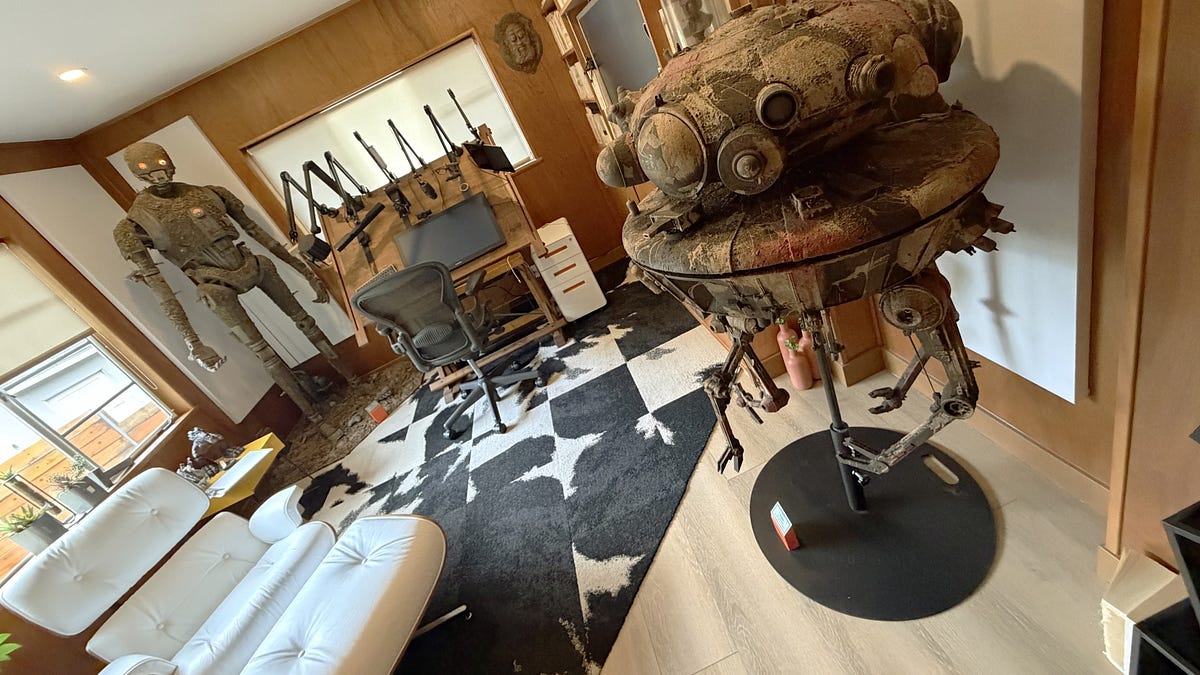
Really Tall Droids on our Substack
Check out this original post on the Make: Substack about the 7-foot tall homemade droids of LA maker Tomasz Opasiński. One of them is named M3CH. “I said to myself, okay, if I’m doing this, I want to do it differently.”
Make Things is a weekly newsletter for the Maker community from Make:. This newsletter lives on the web at makethings.make.co
I’d love to hear from you if you have ideas, projects or news items about the maker community. Email me - [email protected].
