

Best wishes to all the Maker Moms out there.
This week, I was reading Andy Weir’s Project Hail Mary. I know I’m late to the party, with the movie out, but I wanted to read it before seeing the movie. I really enjoyed the book, as much as if not more than “The Martian.” Also, this week I talked with Clément Delangue of Hugging Face about the open-source robotics platform Reachy Mini, produced by Pollen Robotics. Somehow the two seemed part of the same conversation in my head.
Table of Contents
Hugging Face and Hail Mary
Let me start with the Reachy Mini Lite robot, which is a “compact, open-source humanoid robot designed to make robotics accessible, fun, and affordable.” It comes from Pollen Robotics in collaboration with Hugging Face. Here’s a simulation of Reachy Mini from the Hugging Face hub for Reachy Mini.

When he was visiting in April, Eric Pan of SEEED Studio gave me a Reachy Mini Lite kit. SEEED was involved in the manufacturing of Reachy. I was happy to see that Reachy comes with excellent documentation (in print!) and I spent a Saturday afternoon assembling the base, body and head. I should add that my grandson helped me for most of the build; his smaller, more adept fingers were great with the 8mm screws. After 3 hours, I had completed the 46 steps that were described in the “Getting Started” manual.


Once it was fully assembled, I moved on to the last step - turning it on and connecting it to my computer. I downloaded the Reachy app and connected the robot to my computer. The app couldn’t find Reachy. It timed out.
I wrote [email protected] and they suggested I post to the Discord, which I did. I didn’t get any answers and so it has sat beside my desk for a few weeks now. My grandkids ask every time they come over if I have the robot working. “No, I don’t,” I tell them without really answering their unasked question: “Why not?”
Earlier this week, I had a conversation with Clément Delangue, the CEO of Hugging Face. He had sent Make: a message giving us a heads-up on a new development for Reachy Mini.
We're releasing the toolkit that turns Reachy Mini into the first agent-native robot. Anyone can program it end-to-end in natural language. The SDK, the browser simulator, and an AGENTS.md file are all built so an AI coding agent can write, test, and ship apps directly to the robot.
He wrote that:
200+ apps built by beta testers using agents (150+ different
creators, most never wrote robotics code before)3,000 robots shipping this week, install base near 10,000
Hardware and software fully open source
In our conversation, Clément said that Hugging Face has opened an App Store for Reachy. He also showed an example of a Receptionist app that runs on a Reachy Mini in their Miami office. With its Raspberry PI camera eyes, Reachy detects when a person comes in the door, asks them who they want to see and what their name is, and then sends a message to alert the employee about their guest.

Seeing the demo definitely made play around with the apps and see what I could build myself. But, of course, my Reachy Lite was not working. I also dreaded having to disassemble it. I told Clément and said I wished I could have tested the robot as it was being built to see if was working.
Clément connected me with Tom Mulder at Pollen Robotics and, with Tom’s help, I was able to find the source of the problem — a 300 mm motor cable that was not connected — my fault. It was still difficult to fix because the connectors are buried inside the body. I disassembled it halfway but Reachy Mini still sits on my desk, like Humpty Dumpty after a great fall.
Project Hail Mary
I really enjoy reading Andy Weir. He is able to tell compelling stories that are driven by how engineers and scientists think as well as what they do. He invites you to think along with them so you understand what they are doing. Weir is much like the teacher at the heart of this book, Dr. Ryland Grace, who enjoys explaining science to kids. I can’t think of another writer like Weir.
So, as Grace encounters one problem after another, and figures things out, I really wanted to be able to do those things. I wanted to figure out what was wrong with my Reachy Lite. I needed it to work — not that my life depended on it, but you probably know the feeling. I told myself it was for the grandkids.
I had located the cable and connector in the robot’s head and was able to connect it. I thought it would solve the problem but the app still wasn’t detecting the robot. I sent Tom the logs and he said that the motor was still disconnected so the other end of the cable must be loose. I unscrewed the body from the head, and dug around and found the cable.

The trouble was that the connector was not accessible, blocked by another piece of plastic in the center of the body. I’ll have to figure out how to take it all apart now.
Yet another thing I got from reading Project Hail Mary, was the alien, Rocky. If Grace is a scientist, Rocky is an engineer. When something is broken, he says: “I fix it.” And he does, all the time. Grace and Rocky are really the perfect pair, and the surprising thing about the book is their relationship and how close the two of them become. They are different but they work together so well to get hard things done.
So, I began to look at my Reachy Mini a little differently too. I wished I had a friend like Rocky who could fix things I can’t.
There’s a funny part of the book where Grace asks Rocky what name he uses for his ship. Rocky says that the name is “ship”; it doesn’t have its own name. Grace says that boats are given names, for example. Rocky counters, asking him what name he calls the chair. Things don’t have names, he implies. Grace says it’s just something humans do.
I might start calling this robot Rocky Mini. A robot’s about as close to an alien as I’ll ever get and it needs a name of its own.
Community Shop Class in Sacramento
For the MakerEd newsletter this week, I wrote about a group of maker educators meeting at Community Shop Class in Sacramento in “Talking Shop with NorCal Maker Educators.” Chad Orcut calls himself the “Head Janitor” of Community Shop Class, a space he created after opening his garage workshop at home and calling it “The ADHD Inventor’s Club.”

Chad Orcut talks at Community Shop Class
He had an idea for a toy — a combination of skateboard and cornhole. He wondered if he was capable of acting on that idea.
A voice inside my head said: “You’re not smart enough to do that. You don’t read! You barely graduated from high school. You can’t do these things. You’re not a maker; you’re not a teacher; you’re not an educator; you’re not a community advocate.” But the truth is I am all of them. The reason I can stand here and tell you that is that I had an idea in my head and I actually built it.
Chad pointed to a prototype of the toy he made. The prototype never became a product but he remains proud of it. What came out of doing it was Community Shop Class, creating a public space for others to make things.
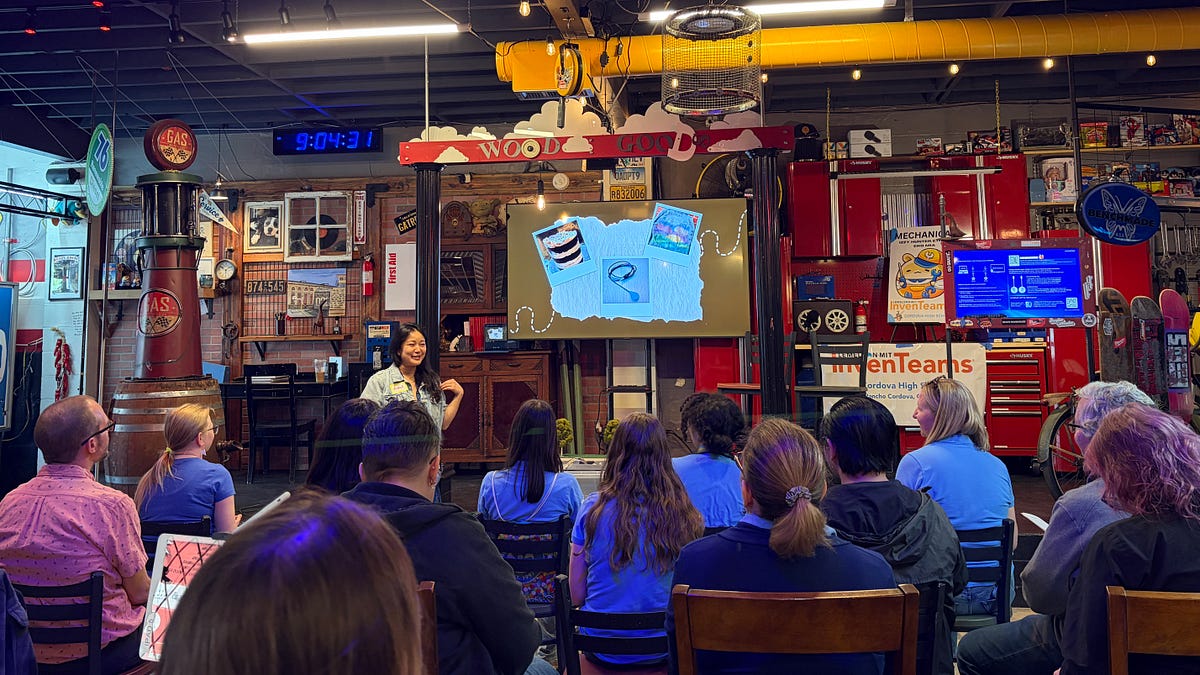

At the NorCal Educators meeting, Rachel Okazaki who is the makerspace director at the Kraus Center for Innovation at Foothill College, gave a talk titled “A Physical Therapist, Pastry Chef and Fiber Artist Walk into a Makerspace.” It does sound like a set up for a joke. However, Rachel had a point to make. She said: “When we ask kids what they want to be, we expect to get a one-word answer back — doctor, teacher, veterinarian.” She went on to explain that she is all the things that she mentioned in the title of her talk. She became a pediatric physical therapist; she ran a home-based bakery and she is a fiber artist who does sashiko, a type of hand embroidery. As a makerspace director at a community college, she said wants to encourage students to explore many interests and what they do in life will be multi-faceted. Rachel said that makerspace can be a “space to become” and develop those different aspects of ourselves.
It reminded me of a term I once heard in Shanghai when a person was introducted to me as a “slashman.” I asked what they meant. It meant they had different names for what they do. This person was a “gallery owner/photographer/maker/artist.” It’s a nice way of thinking of ourselves as multidimensional.
ENIAC replica built by neurodivergent kids
On the Make: Substack, I wrote about Thomas Burick, a teacher at PSA Academy Arizona. It’s an independent school for neurodivergent kids. Those kids built a full-scale, immersive replica of the ENIAC computer, the world’s first general-purpose electronic computer, taking up 500 square feet in the school gymnasium. It took them one semester to build it and it happened to coincide with the 80th anniversary of ENIAC this year.

One thing that stood out for me was Tom himself. Like many makers, he struggled in school yet went out to lead a productive life.
Thomas: I have dyslexia and dyscalculia. In ninth grade, my math scores were atrocious, and my grades in general were atrocious. But as a ninth grader, I’m building microprocessor-controlled robots that can extinguish fires in industrial facilities, literally. My teachers and my school system considered me a failure because I wasn’t getting A’s in math and science and reading. I was told by a guidance counselor my senior year that the best I was ever going to hope for was a minimum wage factory job. I went on to have a very successful computer company and a robotics company for a decade that was covered several times by Make magazine. Now I’m an educator, and I get to pay all that forward to my kids. That was me. I was that kid.

Thomas Burick and a student
The new issue of Make: is out. You can buy individual copies here for yourself or a friend.

Make Things is a weekly newsletter for the Maker community from Make:. This newsletter lives on the web at makethings.make.co
